 |
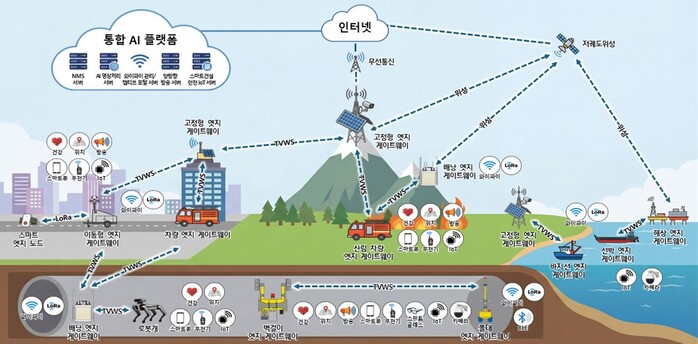
| ▲ 100Mbps 급 TVWS 기반 재난·스마트건설 통신 플랫폼 네트워크(사진: 이노넷 제공) |
[매일안전신문=이종삼 기자] 지난 9일 이노넷 주식회사는 산업통상자원부 산하 한국산업기술진흥원(KIAT)이 추진하는 「2026 규제특례 신산업 창출사업」에 선정돼 재난 및 스마트건설 분야에 적용 가능한 차세대 무선통신 플랫폼의 사업화를 본격 추진한다.
이번 과제는 100Mbps급 고속 TVWS와 저궤도위성, AI 기술을 결합한 통합 AI 플랫폼 개발을 목표로 하며, 통신 인프라가 부족한 환경에서도 안정적인 통신이 가능하다. 즉, 기존 통신이 인프라 구축에 의존하는 구조였다면, 본 기술은 인프라 없이도 즉시 통신망을 구축할 수 있는 구조적 차별성을 갖는다.
이번 사업은 단순 기술 개발을 넘어 실제 산업 적용을 목표로 설계됐다.
특히 스마트건설 분야에서는 중대재해 예방을 위한 통신 및 안전 플랫폼으로 적용되며, 공공기관 긴급 통신 및 재난 대응 서비스 검증이 이루어진다. 이를 통해 기술의 현장 적용성과 사업화 가능성을 동시에 확보할 계획이다.
이노넷은 규제샌드박스를 통해 기술을 단계적으로 발전시켜 왔다. 2019년 이동체 기반 TVWS 와이파이 서비스 실증을 시작으로, 2022년에는 지하터널 스마트건설 안전 솔루션을 적용하며 산업현장으로 확장했다.
이어 2025년에는 긴급 소방 이동기지국과 로봇개를 활용한 재난 대응 통신 서비스를 실증하여, 통신 기술을 AI 및 로봇 기반 서비스로 확장할 예정이다. 이러한 연속적인 실증은 기술의 완성도를 높이고 산업 적용 기반을 확보하는 데 중요한 역할을 했다.
규제샌드박스를 통해 검증된 기술은 올해 2월 전파법 개정으로 이어지며 제도적 기반을 확보하게 됐다. 개정된 제도를 통해 재난 현장에서의 이동형 통신 서비스 적용이 가능해졌으며, 지하 및 통신 취약지역에서도 안정적인 무선통신 구축이 허용됐다.
이에 따라 해당 기술은 실증 단계를 넘어 실제 산업 현장에서 활용 가능한 환경을 갖추게 되었으며, 규제와 기술이 연계된 대표적인 신산업 창출 모델로 평가되고 있다.
이번 사업의 핵심 기술은 기존 대비 대폭 향상된 100Mbps급 TVWS 통신이다. 이를 통해 장거리 및 비가시 환경에서도 안정적인 고속 데이터 전송이 가능하며, 특히 지하·산간·해상 등 통신 인프라 구축이 어려운 지역에서도 활용할 수 있다.
또한 비면허 주파수 기반 기술 특성상 통신요금 부담 없이 대용량 데이터를 처리할 수 있어 경제성이 뛰어난 것이 특징이다. 이러한 구조는 재난 상황에서도 즉시 통신망을 구축할 수 있어 현장 대응 능력을 크게 향상시킬 것으로 기대된다.
기존 재난안전통신망은 보안성이 강화된 폐쇄형 국가망으로 안정적인 통신을 제공하는 장점이 있으나, 외부 인터넷 및 다양한 서비스와의 연계에는 한계가 있다. 반면 TVWS 기반 긴급 재난 대응 네트워크는 인터넷망과 연동되는 개방형 구조로, 다양한 AI 서비스 및 데이터 기반 응용 서비스와 쉽게 결합할 수 있는 것이 특징이다.
또한 TVWS 기반 네트워크는 별도의 통신 인프라 구축 없이도 신속하게 현장에 구축이 가능하며, 저비용으로 운영할 수 있어 재난 현장, 스마트건설, 이동체 기반 서비스 등 다양한 환경에서 빠르고 유연한 대응이 가능하다.
이에 따라 TVWS 긴급 재난망은 기존 국가 재난통신망을 보완하는 역할을 수행하며, 특히 저궤도위성 백홀 배낭/차량 TVWS 이동기지국으로 1시간 이내 구축하여 초기 대응 및 현장 중심 서비스 측면에서 차별화된 경쟁력을 갖는다.
이노넷은 통신 기술을 기반으로 AI 영상 분석, IoT 센서 데이터 수집, 로봇 연동 기능을 통합한 스마트 안전 플랫폼을 함께 개발하고 있다.
특히 2025년 규제샌드박스를 통해 로봇개 기반 데이터 수집과 이동기지국을 연계한 통합 서비스가 검증될 예정이며, 이를 통해 재난 현장에서 실시간 상황 인지 및 대응이 가능한 시스템이 구현되었다. 이러한 플랫폼은 스마트건설, 공공안전, 스마트시티 등 다양한 산업 분야로 확장될 수 있다.
이노넷은 KIAT 사업을 통해 확보한 기술을 기반으로 공공조달 시장과 민간 건설시장, 그리고 해외 시장을 동시에 공략할 계획이다. 조달청 혁신제품 제도를 활용하여 국내 공공시장에 진입하고, 건설사와 협력을 통해 산업현장 적용을 확대한다. 또한 아프리카, 중동, 남미 등 통신 인프라가 부족한 지역을 중심으로 글로벌 시장 진출을 추진하며, 동일 기술 구조를 기반으로 빠른 확산을 목표로 하고 있다.
글로벌 재난안전 시장은 2024년 약 350조 원에서 2030년 약 600조 원 규모로 성장할 것으로 전망되며, TVWS 시장 역시 2032년 약 30조 원 규모로 확대될 것으로 예상된다.
이러한 시장 환경에서 이노넷의 기술은 통신·AI·IoT를 결합한 통합 플랫폼으로서 높은 경쟁력을 갖는다. 특히 규제샌드박스 실증과 법제화를 거쳐 산업화 단계로 이어진 점에서, 이번 사업은 기술 개발을 넘어 실제 시장 창출까지 연결되는 대표적인 사례로 평가된다.
이노넷 유호상 대표는 “중소기업에게 세계 최초의 제품 개발 및 글로벌 진출을 동시에 제공하고 있는 규제샌드박스는 기술 검증 기회를 제공하고 전파법 개정을 통해 제도적 기반을 확보함으로써 산업화로 이어지는 구조를 완성했다”며 “이번 KIAT 사업을 통해 스마트건설과 공공안전 분야에서 세계 최초의 기술로 본격적인 시장 확장을 추진하고 글로벌 진출을 가속화할 것”이라고 밝혔다.
또한 TVWS 기술기준을 담당하는 국립전파연구원 성주영 박사는 “2026년 2월 전파법 개정은 규제샌드박스 제도를 통해 다양한 혁신 기술도 법적 틀 안에서 검증되고 다양한 혁신적 AI 서비스가 출현할 수 있는 통신요금 없는 고속통신 인프라를 제공하였다는 점에서 의의가 있었다”며 “다양한 산업 현장에서 글로벌 이동체 AI 혁신 서비스를 위한 최고 기업이 출현할 수 있는 무선통신 인프라를 제공할 것이다”고 말했다.
다음은 위 기사의 영문판이다.
Innonet, Selected in KIAT’s ‘New Industry Creation Project Based on Regulatory Sandbox’
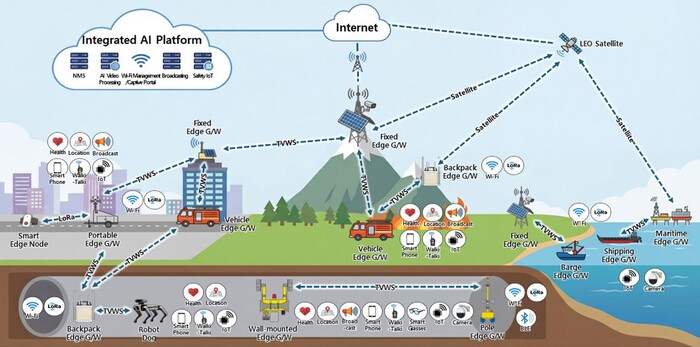 |
| ▲ 100Mbps-class TVWS-based Disaster and Smart Construction Communication Platform Network(photo courtesy of INNONET) |
[Maeil Safety News = Reporter Lee Jong-sam] On April 9, INNONET was selected for the “2026 New Industry Creation Project Based on Regulatory Sandbox” promoted by the Korea Institute for Industrial Technology Advancement (KIAT), under the Ministry of Trade, Industry and Energy. INNONET will now proceed in earnest with the industrialization of a next-generation wireless communication platform applicable to the disaster and smart construction sectors.
This project aims to develop an integrated AI platform combining 100Mbps-class high-speed TVWS, low-orbit satellites, and AI technology, enabling stable communication even in environments lacking communication infrastructure. In other words, while existing communication relied on infrastructure construction, this technology possesses a structural differentiation that allows for the immediate establishment of a communication network without the need for infrastructure.
This project is designed to go beyond simple technology development and aim for actual industrial application.
In particular, within the smart construction sector, it will be applied as a communication and safety platform for preventing major accidents, while verification of emergency communication and disaster response services for public institutions will be conducted. Through this, the company plans to simultaneously secure the field applicability and commercialization potential of the technology.
INNONET has progressively advanced its technology through the Regulatory Sandbox. Starting with the demonstration of mobile-based TVWS Wi-Fi services in 2019, the company expanded into industrial sites in 2022 by applying smart construction safety solutions to underground tunnels.
Subsequently, in 2025, the company plans to expand communication technology into AI and robot-based services by demonstrating disaster response communication services utilizing emergency fire mobile base stations and robot dogs. These continuous pilot projects have played a crucial role in enhancing the completeness of the technology and securing a foundation for industrial application.
Technologies verified through the regulatory sandbox have secured an institutional foundation following the amendment of the Radio Waves Act in February 2026. The revised system has enabled the application of mobile communication services at disaster sites and has permitted the establishment of stable wireless communication even in underground and communication-vulnerable areas.
Consequently, the technology has moved beyond the demonstration phase and now possesses an environment where it can be utilized in actual industrial settings; it is being evaluated as a representative model for creating new industries by linking regulation and technology.
The core technology of this project is 100Mbps-class TVWS communication, which has been significantly improved compared to existing standards. This enables stable high-speed data transmission even over long distances and in non-line-of-sight environments, and allows for utilization in areas where establishing communication infrastructure is difficult, such as underground, mountainous, and offshore regions.
Furthermore, due to the nature of the technology based on unlicensed frequencies, it is characterized by excellent economic efficiency as it can process large volumes of data without the burden of communication fees. This structure is expected to significantly enhance on-site response capabilities by enabling the immediate establishment of communication networks even in disaster situations.
The PS(Public Safety)-LTE Network is a closed national network with enhanced security that offers the advantage of stable communication, but it has limitations in integration with the external internet and various services. In contrast, the TVWS-based Emergency Disaster Response Network features an open structure that links with the internet, characterized by its ability to easily integrate with various AI services and data-based application services.
Furthermore, the TVWS-based network can be rapidly deployed on-site without the need for separate communication infrastructure and can be operated at low cost, enabling fast and flexible responses in diverse environments such as disaster sites, smart construction, and mobile-based services.
Accordingly, the TVWS Emergency Disaster Network serves to complement the existing national disaster communication network. In particular, it possesses differentiated competitiveness in terms of initial response and field-oriented services by being deployed within one hour using low-orbit satellite backhaul backpack/vehicle TVWS mobile base stations.
INNONET is jointly developing a smart safety platform that integrates AI video analysis, IoT sensor data collection, and robot integration functions based on communication technology.
In particular, an integrated service linking robot dog-based data collection with mobile base stations is scheduled to be verified through the 2025 Regulatory Sandbox. Through this, a system capable of real-time situational awareness and response at disaster sites has been implemented. This platform can be expanded to various industrial sectors, including smart construction, public safety, and smart cities.
Based on the technology secured through the KIAT project, INNONET plans to simultaneously target the public procurement market, the private construction market, and overseas markets. It will enter the domestic public market by utilizing the Public Procurement Service's Innovative Product system and expand its application in industrial sites through cooperation with construction companies. Furthermore, it is pursuing entry into the global market, focusing on regions lacking telecommunications infrastructure such as Africa, the Middle East, and South America, aiming for rapid diffusion based on the same technological structure.
The global disaster safety market is projected to grow from approximately 350 trillion won in 2024 to about 600 trillion won in 2030, and the TVWS market is also expected to expand to approximately 30 trillion won by 2032.
In this market environment, Innonet's technology possesses high competitiveness as an integrated platform combining telecommunications, AI, and IoT. In particular, this project is evaluated as a prime example of moving beyond technology development to actual market creation, as it progressed to the industrialization stage following regulatory sandbox demonstrations and legislative enactment.
INNONET CEO Yoo Ho-sang stated, "The regulatory sandbox, which provides SMEs with the simultaneous development of world-first products and global expansion, has completed a structure leading to industrialization by offering opportunities for technology verification and securing an institutional foundation through the amendment of the Radio Waves Act." He added, "Through this KIAT project, we will pursue full-scale market expansion in the smart construction and public safety sectors with world-first technologies and accelerate our global expansion."
In addition, Dr. Sung Joo-young of the National Radio Research Institute, who is in charge of TVWS technical standards, stated, “The amendment to the Radio Waves Act in February 2026 was significant in that it provided a high-speed communication infrastructure free of communication fees, allowing various innovative technologies to be verified within a legal framework through the regulatory sandbox system and enabling the emergence of diverse innovative AI services.” He added, “It will provide a wireless communication infrastructure that enables the emergence of top companies for global mobile AI innovation services in various industrial fields.”
[ⓒ 매일안전신문. 무단전재-재배포 금지]